
The flagship page for Okta posture, evidence, and follow-through.
One read-only assessment record becomes a dashboard, finding queue, evidence package, report, supported export, and delivery plan.
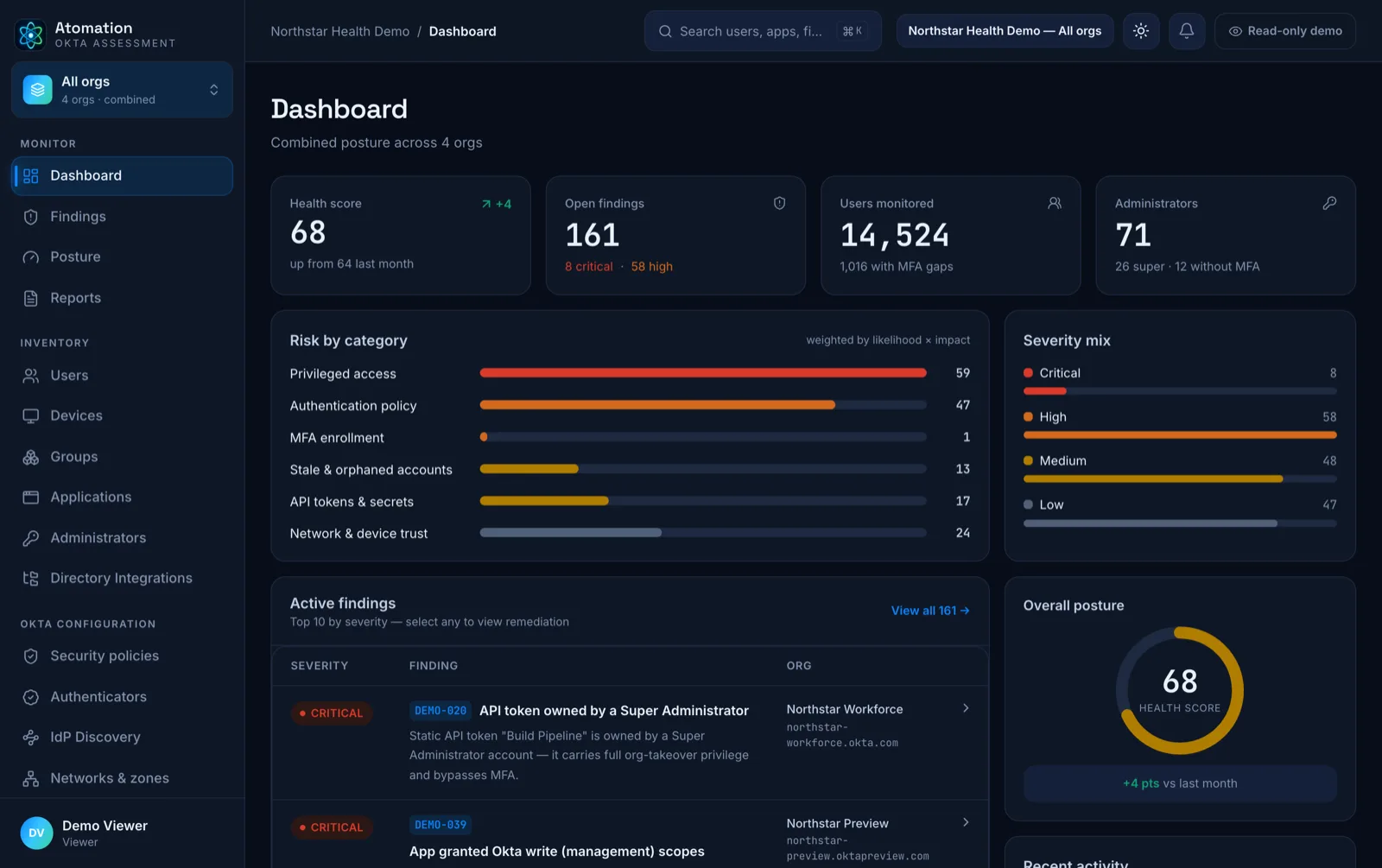
A review console instead of a brochure grid.
The platform story is organized around the work teams actually do: review the queue, open the evidence, route the owner, and export the report.
Users, groups, apps, policies, admins, log-stream configuration, service access, and supplied context.
Severity, affected objects, source evidence, screenshot, and recommendation.
Executive summary, operator detail, framework language, exports, and handoff notes.
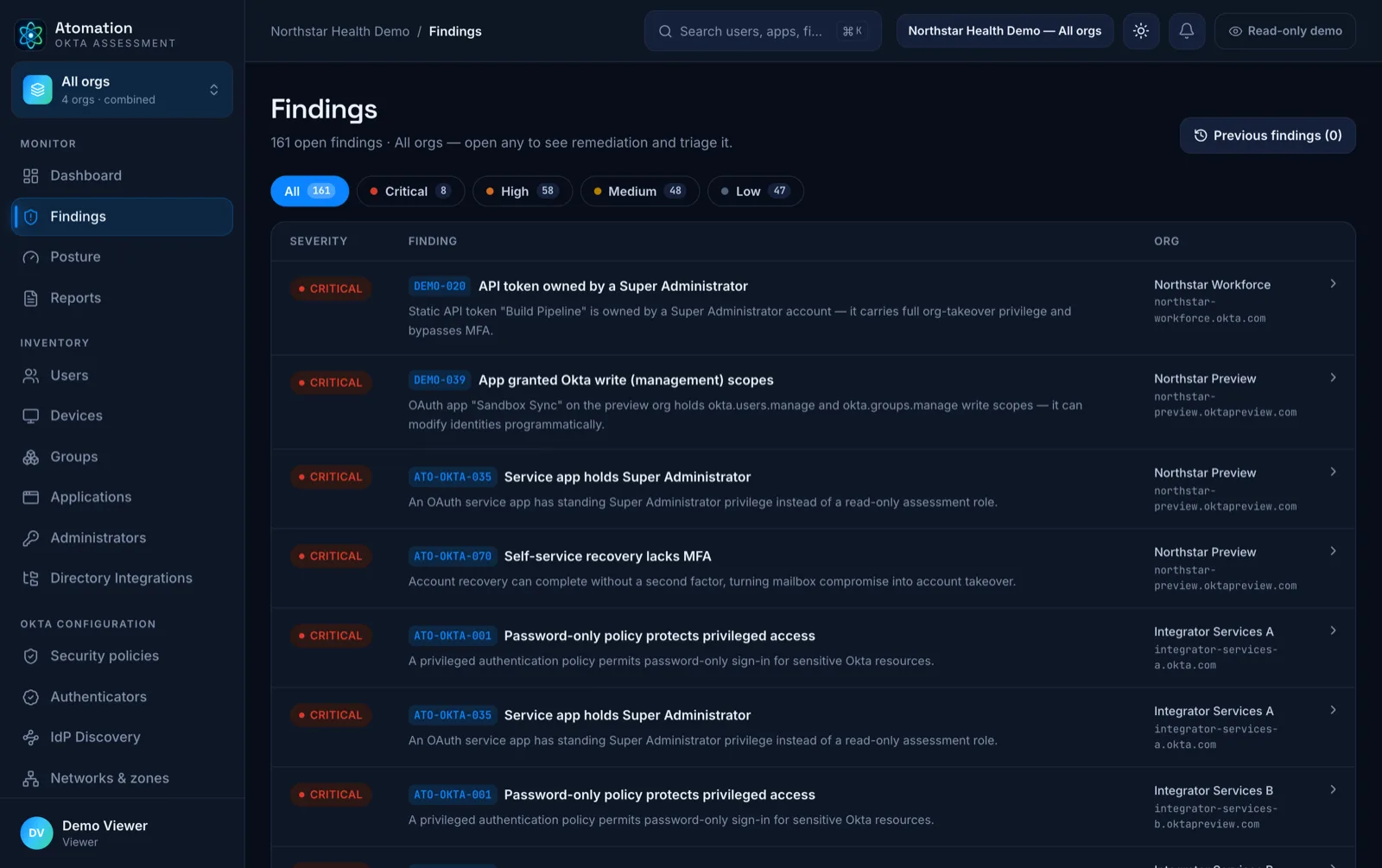
Representative checks, grouped for scanning.
Public pages show the review shape without publishing the full detection playbook.
Privileged access is where small Okta mistakes become major exposure.
Super Admin exposure, Admin role drift, Powerful service-app accessReview stale access, group sprawl, and sensitive app assignments.
Stale access signals, Group and assignment sprawl, Sensitive app access reviewCheck policy coverage, MFA posture, exceptions, and assurance levels.
Policy coverage gaps, Exception and overlap review, Admin and high-value app assuranceNon-human access, integration access, and service credentials are reviewed for ownership, privilege, and hygiene.
Ownership and privilege review, Stale or concentrated access, Integration hygieneReview log-stream configuration and customer-supplied monitoring evidence without claiming raw System Log collection.
Log-stream configuration, Customer-supplied alert evidence, Framework and control mappingSurface renewal and cost questions tied to observed usage.
Utilization patterns, Stale entitlement signals, Renewal planning context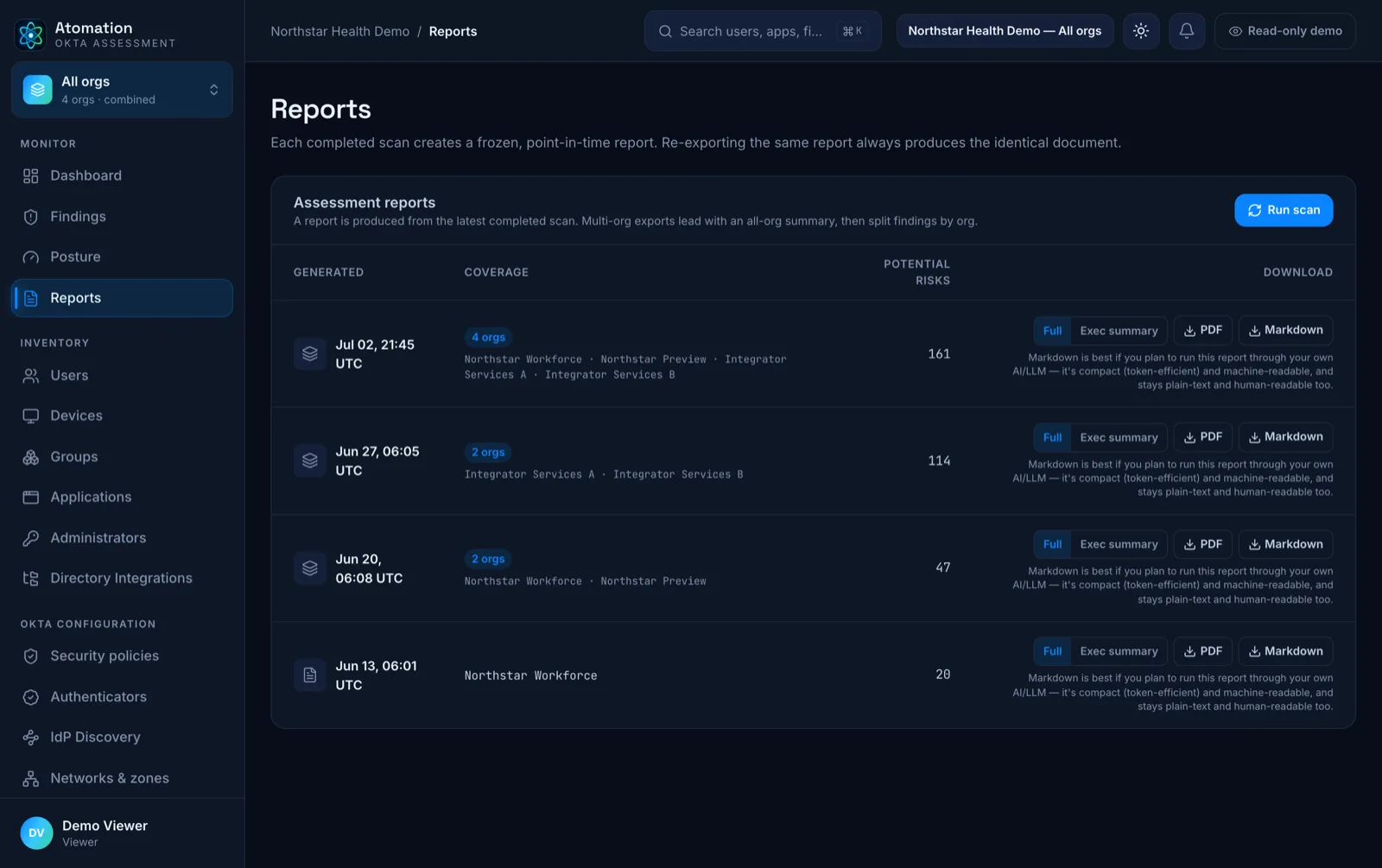
Screenshots, objects, findings, and reports stay connected.
The assessment does not make teams reassemble raw exports. Evidence is packaged around the finding and reused in reports, framework mapping, and the supported export formats.
Open evidence pageChoose a service path without losing the evidence trail.
Start with the smallest useful review and expand only when cadence or support justifies it.
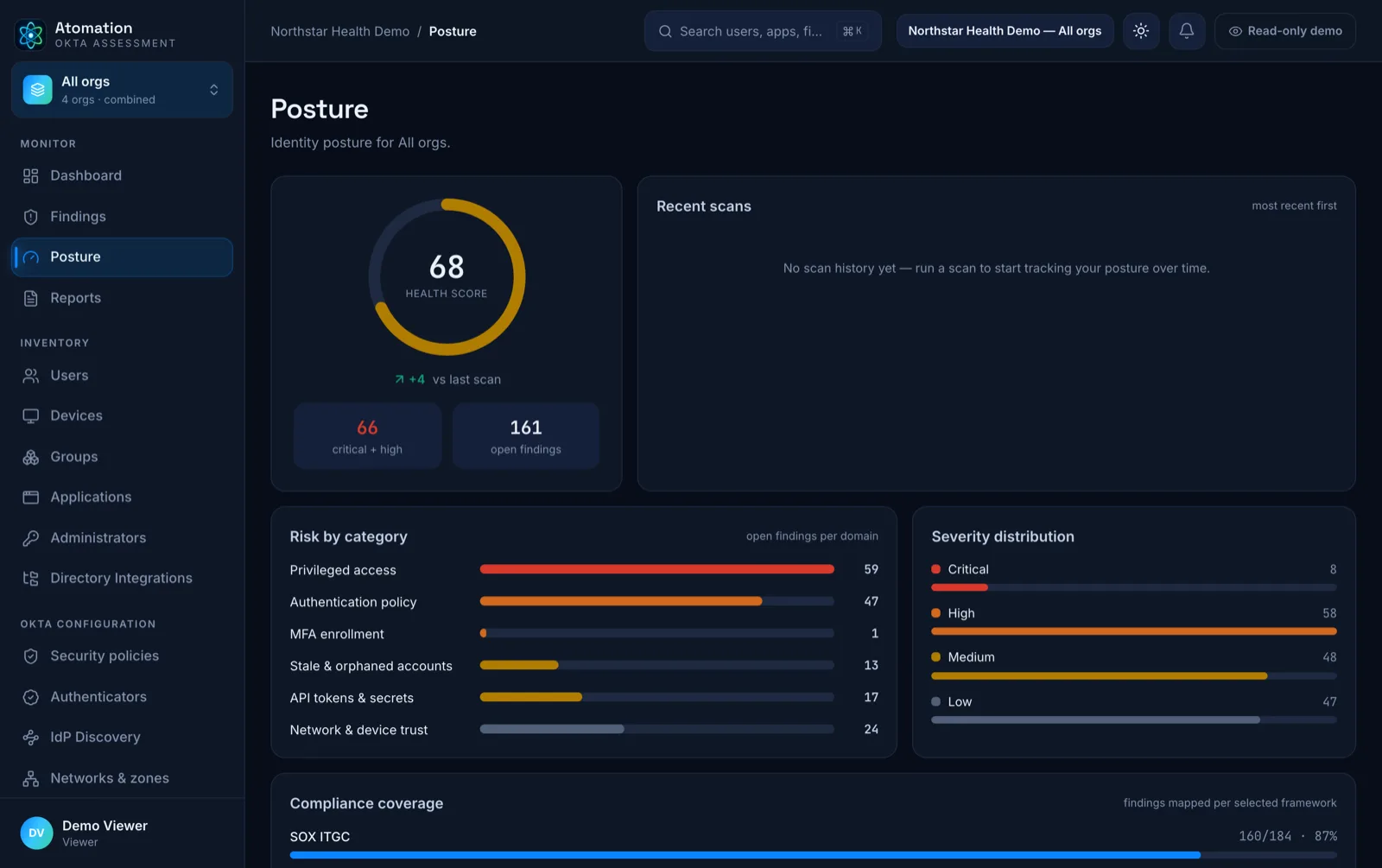
A focused Okta assessment for audit prep, diligence, renewal planning, implementation handoff, incident review, or a leadership update.
Planned scheduled re-scans, drift comparison, and trend reporting. These capabilities are not part of the current production portal and should not be sold as live.
Scoped follow-up help for teams that want Atomation-supported review, prioritization, and resolution planning after the first report.
Same evidence, different review lenses.
Findings can be organized around framework language, the hosted workspace boundary, written data-handling terms, and customer-approved routing.
Atomation hosts the portal, control plane, scans, reports, backups, releases, and operations. Control-plane connector private keys and supported stored connector secrets use AES-256-GCM encryption at rest.
Atomation-hostedApproved pilot partners get a hosted portal at {partner-slug}.atomation.io. Partner records link users to customer workspaces; final authorization hardening and validation must finish before live client onboarding.
Atomation-hostedEach client gets a tenant-addressed hosted workspace at {client-slug}.atomation.io with its own connected Okta orgs, scans, findings, reports, and selected application audit events. The public product does not promise an enforced retention tier.
Atomation-hostedCurrent setup assigns Super Administrator to the permanent API Services app and grants 31 assessment reads plus okta.appGrants.manage. Routine scan tokens request only the reads. Okta's management scope is org-level, not self-only; Atomation reserves it for a future reviewed workflow targeting the configured connector app.
Atomation-hostedUse this page as the product story. Keep docs for technical detail.
The older technical setup, framework, report, and security pages stay available under Resources for buyers and operators who need them.