Service Models

Three service paths for different levels of follow-through.

Start with a baseline assessment. Add an on-demand follow-up review or remediation support only when the finding queue and business pressure justify it. Automated scheduling, drift comparison, and trends remain roadmap work.

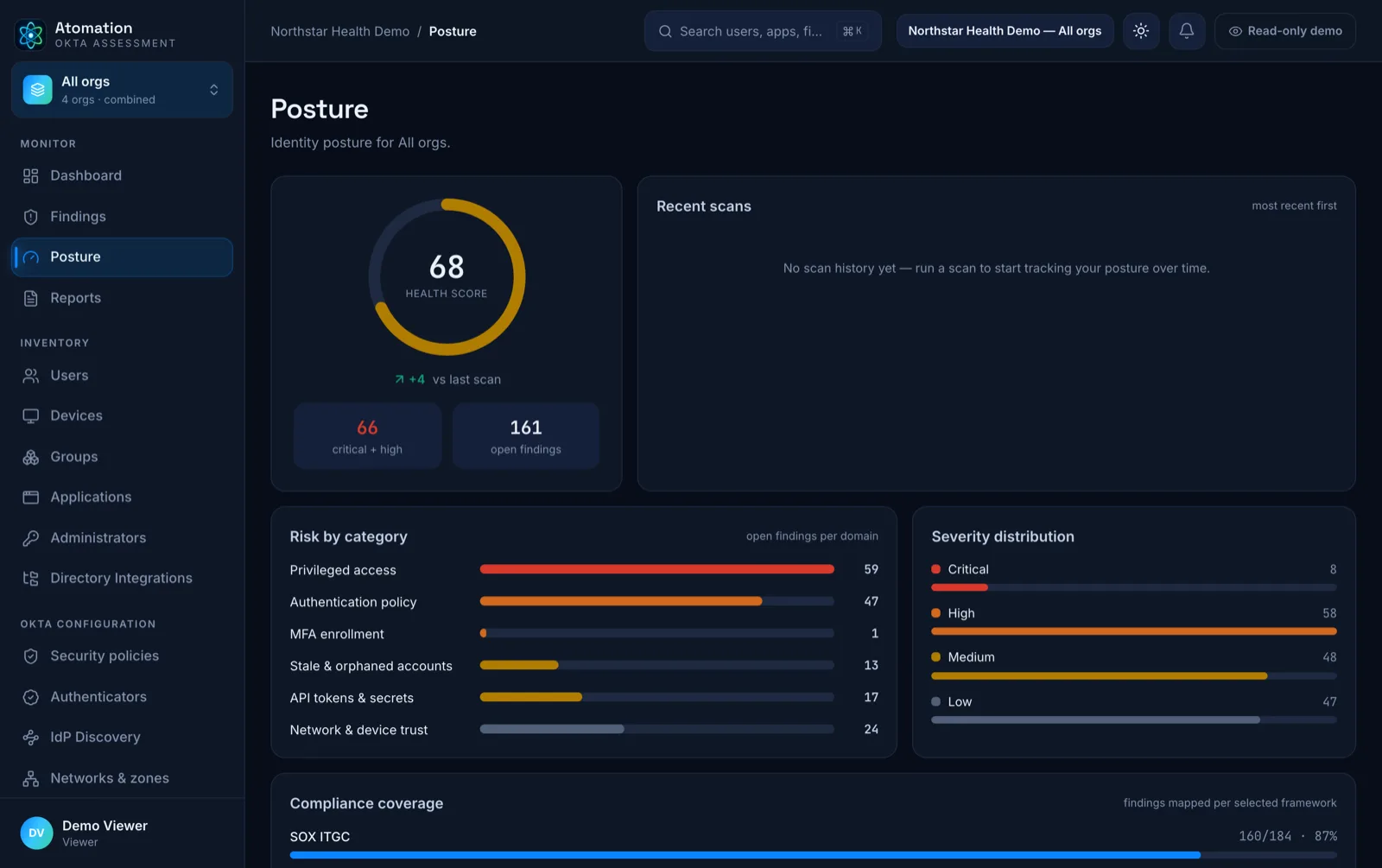
Atomation posture — Okta security posture by category with snapshot inventory
Service paths

Current service paths plus a clearly labeled roadmap.

Point-in-time

Baseline Health Check

A focused Okta assessment for audit prep, diligence, renewal planning, implementation handoff, incident review, or a leadership update.

Audit or diligence
  • Snapshot and findings report
  • Executive summary
  • Framework evidence mapping
  • Alert coverage review
Roadmap

Automated Monitoring

Planned scheduled re-scans, drift comparison, and trend reporting. These capabilities are not part of the current production portal and should not be sold as live.

Roadmap only
  • Future scheduled scans
  • Future drift comparison
  • Future trend reporting
  • Current manual reruns
Services

Remediation Support

Scoped follow-up help for teams that want Atomation-supported review, prioritization, and resolution planning after the first report.

Owner follow-through
  • Finding review sessions
  • Prioritized fix plan
  • Manual recommendation steps
  • Roadmap support
Finding reduction path

Move from the first scan to owner review and a later reassessment.

The page should explain Atomation through movement: finding volume, owner routing, evidence packaging, and a later on-demand scan without implying automated trend analysis.

First scan

Risk is visible

4 Urgent25 High

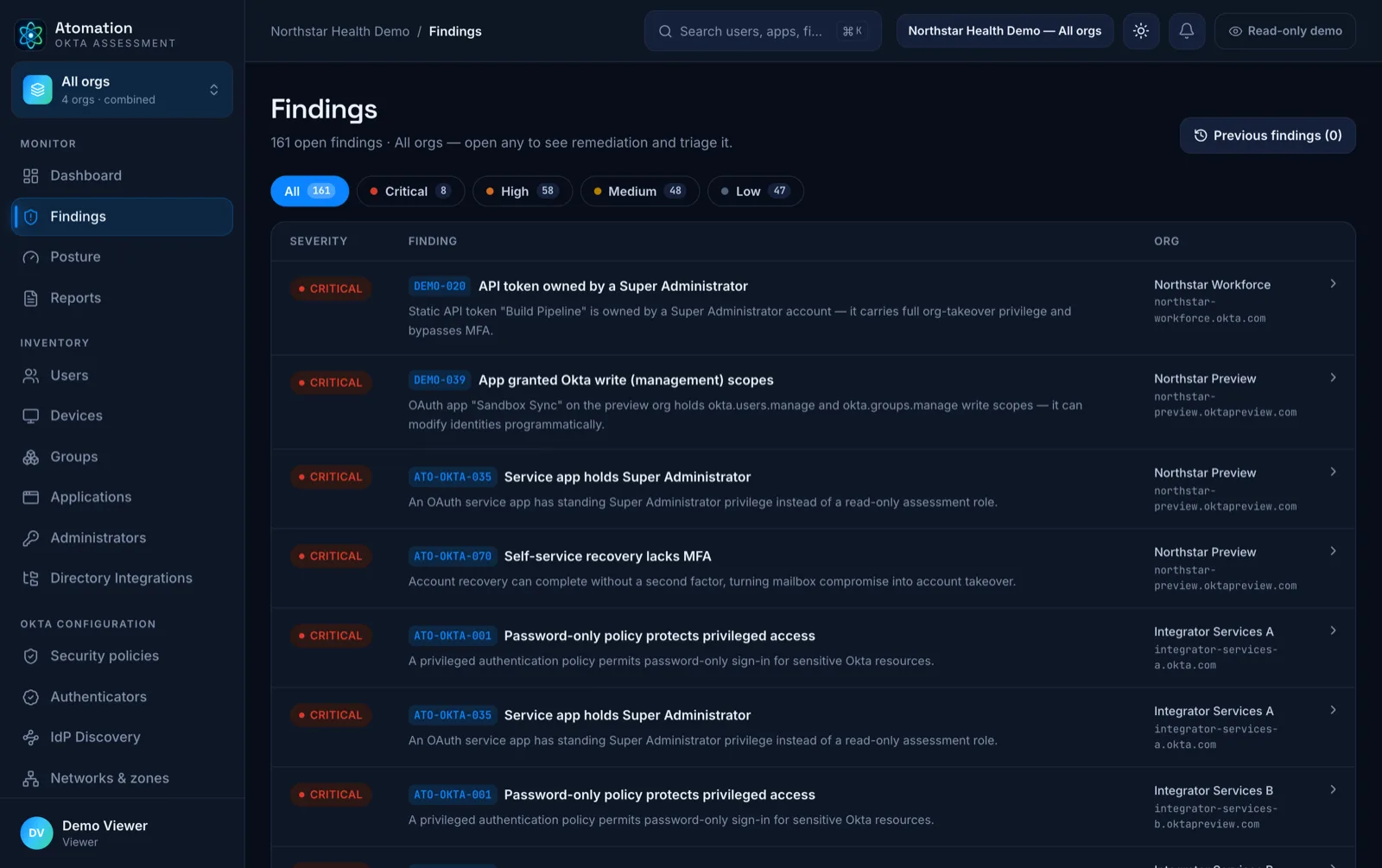
Privileged access, stale assignments, and missing evidence move into one queue.

1 week later

Owners are moving

1 Urgent9 High

Review sessions route the highest-risk findings and attach the proof trail.

Later on demand

Current state is reassessed

New scanManual compare

A later scan creates a new point-in-time result. Automated drift comparison and trend reporting are roadmap features.

Which model fits?

Choose by the pressure in front of the team.

Baseline and remediation support are current service paths. A later assessment can be run on demand. Automated schedules, drift comparison, trend reporting, and enforced retention tiers are not current production capabilities.

Baseline Health Check
Audit, renewal, diligence, leadership update

Point-in-time posture, findings, and evidence package.

Scope
Manual Follow-up Review
Post-cleanup or material Okta change

A new on-demand assessment and manual before-and-after review.

Scope
Remediation Support
Findings require owner review or implementation planning

Review sessions, prioritized fix plan, and handoff context.

Scope
Atomation findings queue — severity-ranked Okta findings with owners and evidence
Scope drivers

Pricing follows evidence, review support, and workspace shape.

The assessment scope follows the evidence needed, desired manual follow-up, and hosted delivery path.

  • Number of Okta orgs
  • Okta Production versus Okta Preview environments
  • User, group, app, policy, admin, API token, and log-stream configuration volume
  • Baseline assessment versus manual follow-up reviews
  • Written data-retention or deletion requirements
  • Framework mapping depth
  • Alert and SIEM evidence review
  • Licensing analysis
Get started

Start with the smallest useful Okta review.

The first report should decide whether a baseline is enough or whether a manual follow-up review or remediation support is worth adding.