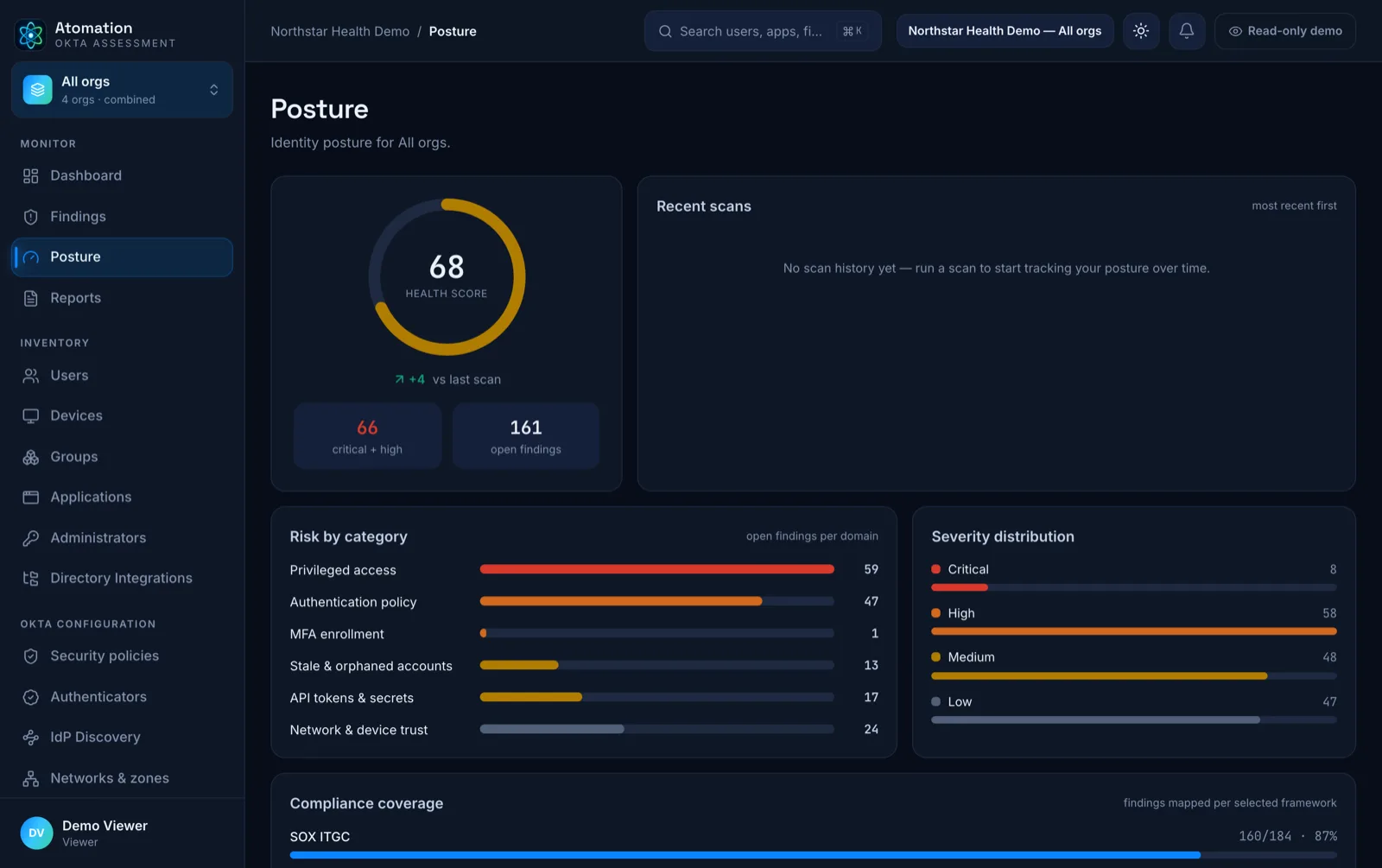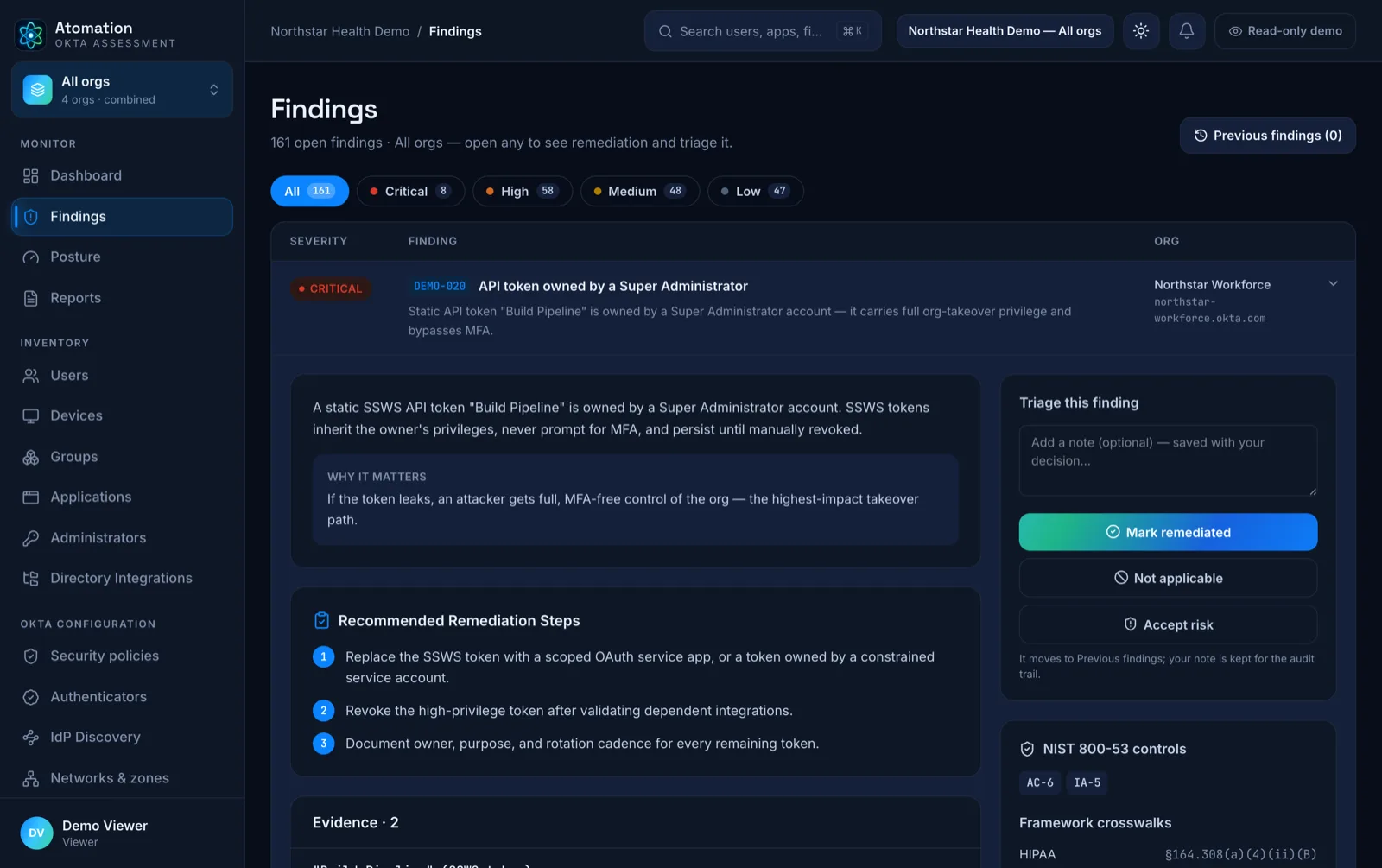
What we check

Representative Okta checks, organized by business risk.

Atomation reviews the areas that shape Okta posture, audit readiness, alert coverage, and renewal planning, then turns the evidence into prioritized findings with context and next steps.

Security posture checks Compliance checks Alert/SIEM coverage checks Licensing review
Coverage areas

A full-org review without publishing the rule catalog.

These are representative categories, not the full detection library, scoring model, fixture set, threshold list, or implementation detail.

Users and lifecycle posture

Dormant users, never-used accounts, status drift, lifecycle gaps, and profile patterns that need review.

  • Dormant and never-used accounts
  • Suspended or staged-user drift
  • Lifecycle and profile review patterns

Groups and assignments

Group sprawl, risky assignments, access creep, and membership patterns that create hidden exposure.

  • Overgrown access groups
  • High-risk app assignments
  • Nested or stale membership patterns

Applications and app access

App assignment posture, stale integrations, risky app patterns, SWA/password-replay exposure, and service app risk.

  • SWA/password-replay exposure
  • Stale or sensitive applications
  • Service app and OAuth grant posture

MFA and sign-on policies

MFA coverage gaps, policy overlap, weak rules, app-specific exceptions, and sign-on behavior that needs review.

  • Apps allowed without MFA
  • Weak or overlapping rules
  • Admin and high-value app assurance

Administrators and privileged access

Super Admin exposure, admin role assignments, custom admin patterns, and privileged access drift.

  • Super Admin exposure
  • Individual and group-based role grants
  • Custom admin role sprawl

API tokens and service access

Stale tokens, human-owned service access, excessive token footprint, and integration hygiene.

  • Human-owned API tokens
  • Stale or concentrated token ownership
  • Service credential hygiene

Security configuration

ThreatInsight posture, trusted origins, network/security settings, and org-level configuration gaps.

  • ThreatInsight posture
  • Trusted origins and network zones
  • Org-level security settings

System Log and alert evidence

Whether the Okta events that matter are visible, routed, covered, and reviewable.

  • Admin and policy event visibility
  • App assignment event coverage
  • Splunk / SIEM evidence review

Compliance evidence

Findings mapped to HIPAA, SOX ITGC, CMMC, GLBA/FFIEC, and customer-provided controls.

  • Framework and control mapping
  • Evidence packaging
  • Executive and detailed report context

Licensing and entitlements

Agreement context, purchased products, observed usage, entitlement patterns, and optimization opportunities.

  • Unused or underused products
  • Stale assignments
  • Renewal-planning questions
Evidence and reporting context

Findings are written for investigation and action.

Each finding is designed to show what was found, why it matters, what evidence supports it, and which team needs to review it. The report can support IAM owners, security teams, compliance teams, finance, procurement, and leadership without turning the review into a spreadsheet exercise.

Security posture checks

Review users, groups, apps, policies, MFA, administrators, API tokens, service access, and org-level security settings.

Compliance checks

Map Okta findings to HIPAA, SOX ITGC, CMMC, GLBA/FFIEC, and customer-provided control language where applicable.

Alert/SIEM coverage checks

Compare Okta System Log context and supplied Splunk or SIEM alerting evidence against the risks surfaced by the posture review.

Licensing and entitlement review

Review customer-provided agreement context, observed usage, purchased products, assignments, and renewal-planning questions.

Public boundary

Atomation keeps the public checks page representative. Exact thresholds, scoring internals, rule IDs, fixture-level details, and customer-specific detections stay out of public copy.

Next step

Want this run against your Okta org?

Start with a baseline health check, then decide whether continuous monitoring, compliance reporting, alert coverage review, or licensing analysis should continue after the first report.