
Executive summary
Themes, severity counts, top risks, and clearly labeled narrative context.
Assessment output stays readable without stripping out the evidence IAM owners need for validation, remediation, audit support, and renewal conversations.
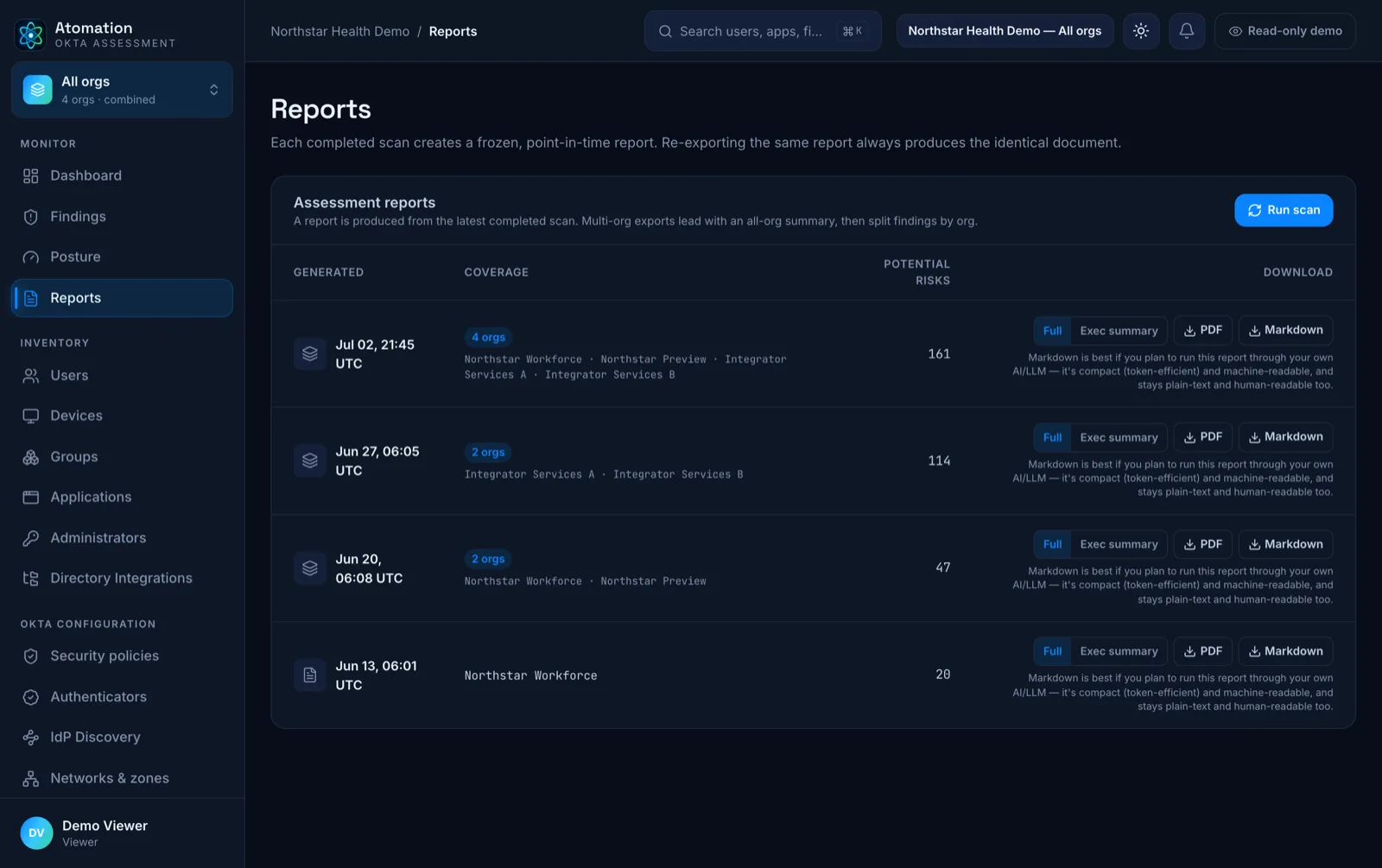
The concise report gives leadership the prioritized view. The detailed operator view carries evidence, screenshots, excerpts, and notes for validation.
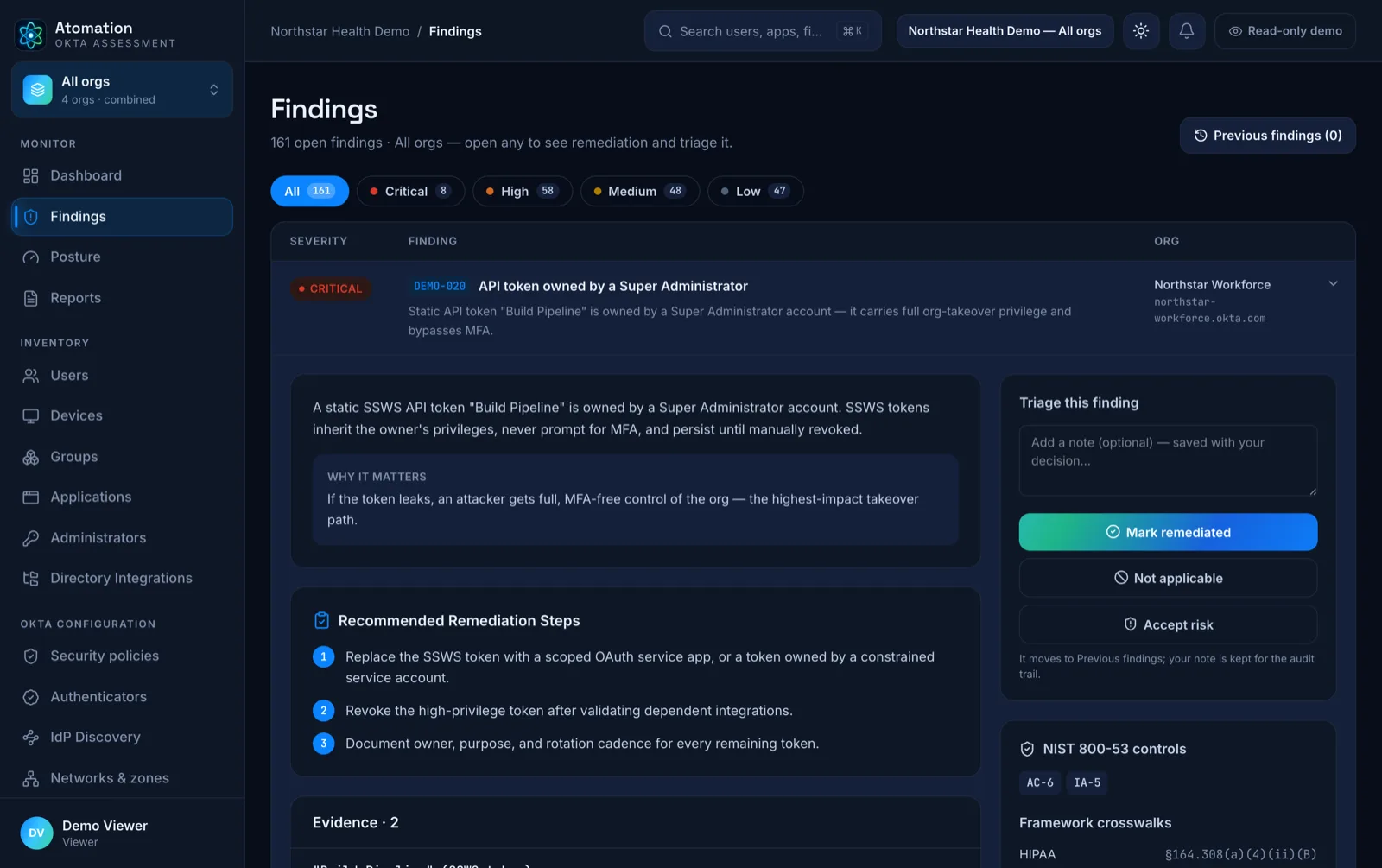
Each section is designed to move from leadership context into operator evidence.
Themes, severity counts, top risks, and clearly labeled narrative context.
Usage, dormant accounts, underused capabilities, and renewal-planning questions when scoped.
MFA posture, session lifetime, weak factors, admin policy, and app-specific exceptions.
Admin assignments, custom roles, service apps, API tokens, resource sets, and ownership patterns.
Severity, category, framework mappings, affected entities, and recommended next steps.
Passed checks, observations, methodology, glossary, and detailed evidence for operator review.
Reports export as PDF or Markdown. Supported inventory views export CSV. DOCX, raw JSON, and raw snapshot downloads are not active portal features.
Presentation-ready report for leadership, audit packets, and internal review.
Generated from the point-in-time assessment state available to that view.
Portable text version for tickets, knowledge bases, and evidence repositories.
Generated from the point-in-time assessment state available to that view.
CSV download on supported filtered inventory views. This is not a raw snapshot or universal finding export.
Generated from the point-in-time assessment state available to that view.
Findings are produced by deterministic checks against captured snapshot evidence. Current report paths do not require an external AI service, and narrative text never determines whether a finding exists.